Turley Knives
Cart 0
 

Turley Catalog


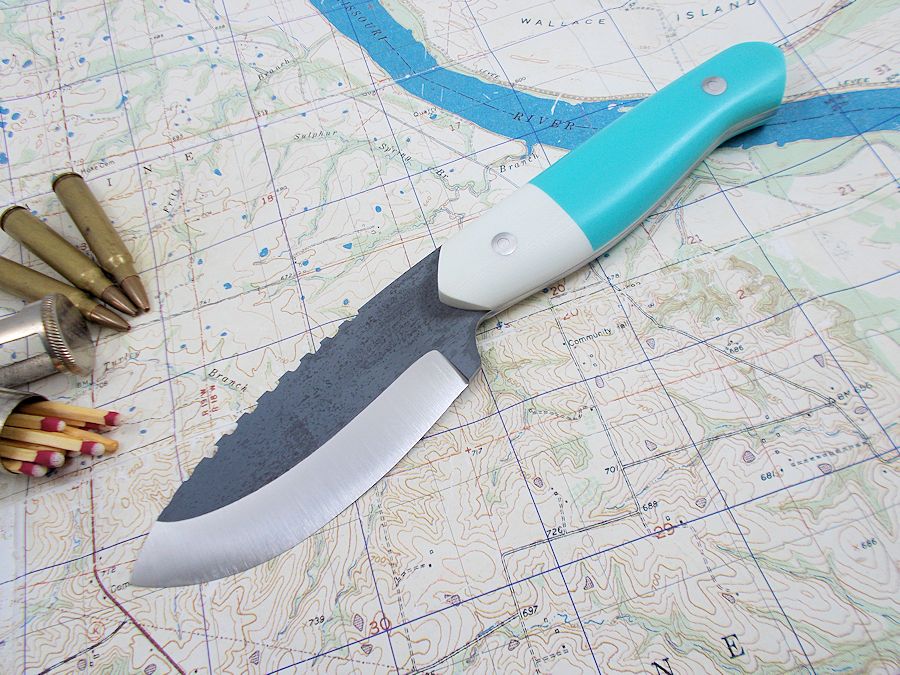
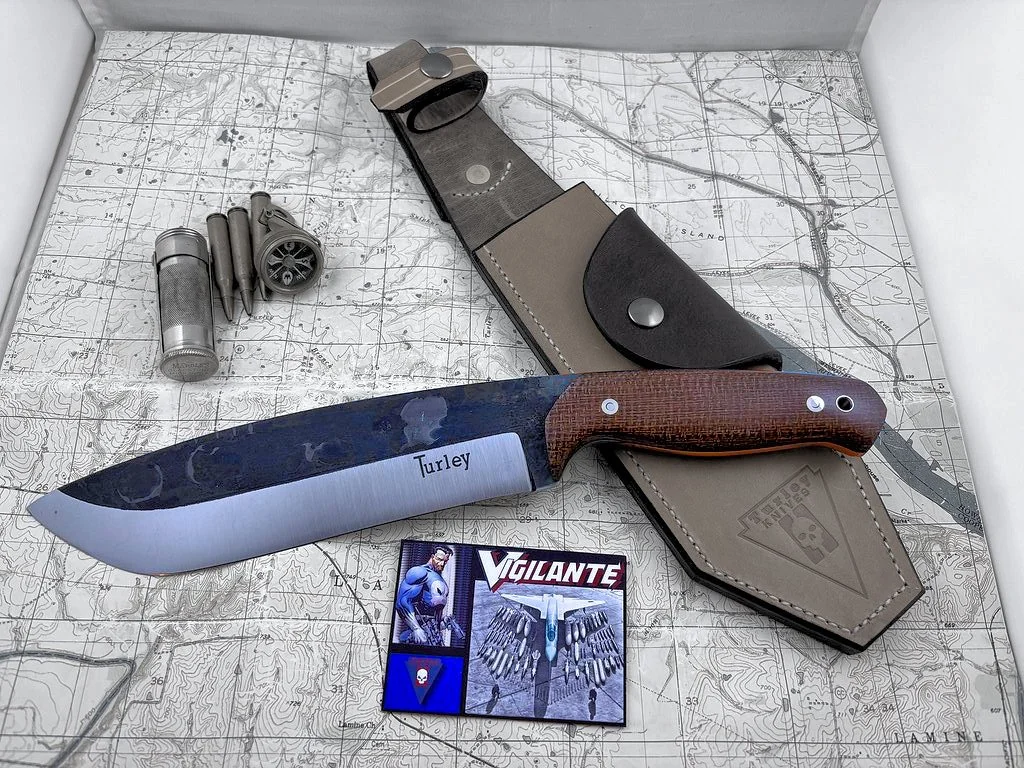
M1 Gasconade

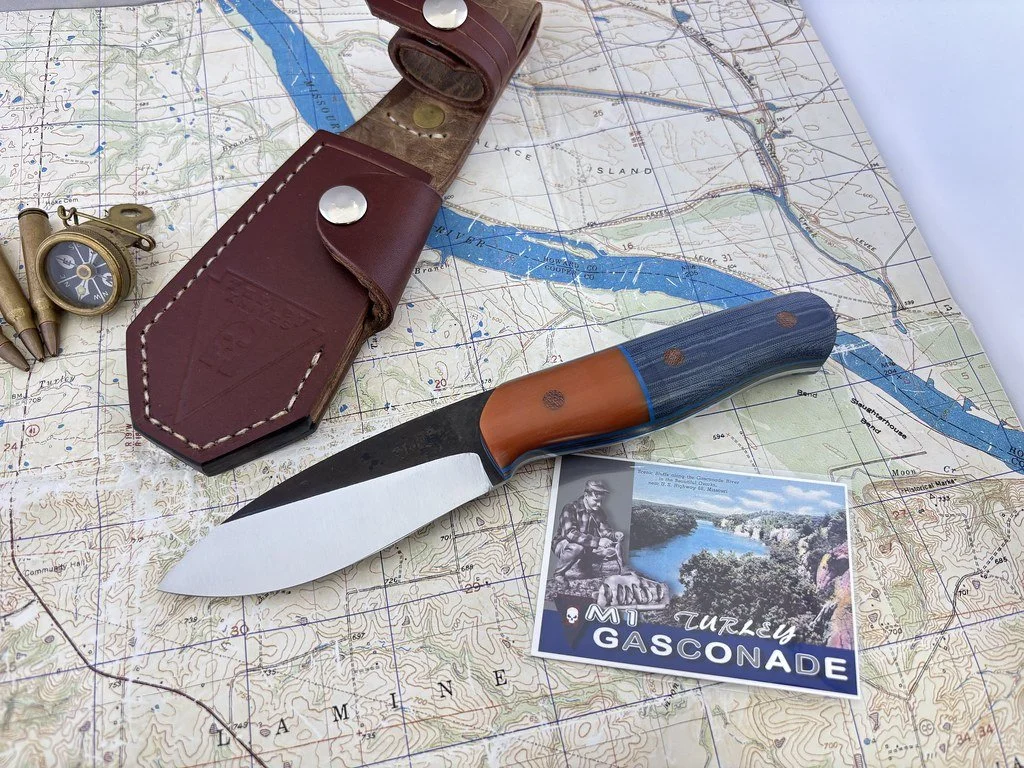
The Model 1 Gasconade is the fruit of many lessons learned projects in the woods. If I'm not in the shop, then I'm probably in the woods. So this design was inevitable for me to come to at some point. 

It features a very severe drop that falls to just below the center of the blade. This serves three purposes, it allows for easier drilling with the tip, allows for an easier time gutting and allows you to split wood with the edge of the tip. 

In order to get this massive drop and still have a straight cutting edge I had to compensate by lowering the rest of the knife. It's actually a very comfortable knife to use because of the drop. This knife and the Green river are pretty much the culmination of my own woods experience and reflect best how I use a knife. This knife was the first of the unique Turley designs that most every knife in the lineup displays today. 

Available in hidden tang or full tang configuration

Blade length: About 3 3/4"

Handle length: About About 4 3/8"

Thickness available: 1/8" full tang only, 5/32", 3/16", 1/4"

Available in stainless or high carbon steel

Base price includes: o-1 tool steel, any commonly available micarta or g10 handle material and stainless handle bolts

See options pages for extra options and pricing:

Base price:  Full tang- $575.00

Hidden Tang base price: $650.00
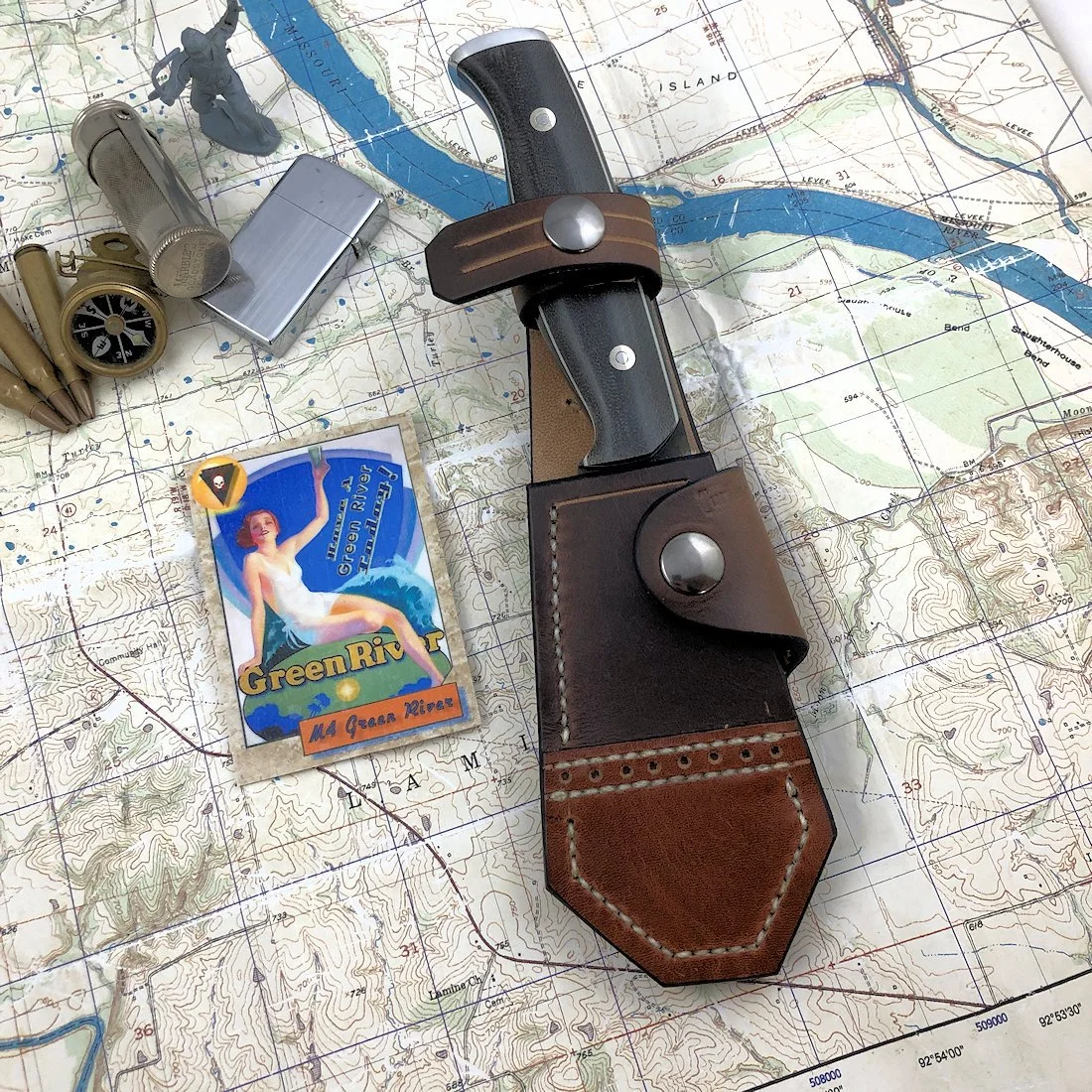
Standard Leather Coffin sheath (handmade using Wickett &Craig and/or Horween premium leather) available: $175.00

**Airborne sheath option shown
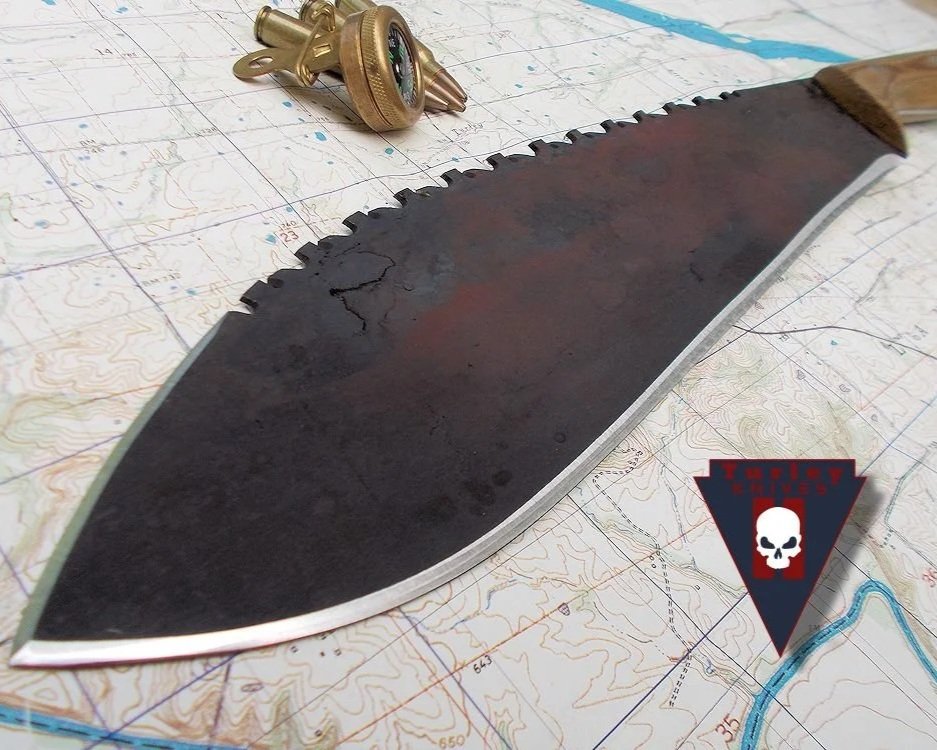
M2 Vigilante

The Vigilante is for all the big knife fans out there. It’s what I would classify as a big knife or small chopper. The design elements for the Model 2 come from the Gasconde river in that
it has a huge sweep downward toward the tip. Combined with the downward
sweep of the handle, the Vigilante is a chopping beast. The edge, as you’ll notice, has been dropped down with the point to keep it straight for ease of sharpening instead of making it a
Recurve. 
  That’s about all there is to say on the Subject. It’s big, it’s bad and it’s tough.

Available in full or hidden tang versions

Not available in stainless steel

Blade length: About 8"
Handle length: About 5 1/2"
Available in 1/4" 5160 spring steel only

Thickness available: 1/8" full tang only, 5/32", 3/16", 1/4"

Available in stainless or high carbon steel

Base price includes: 5160 spring steel, any commonly available micarta or g10 handle material that’s big enough for this monster and stainless handle bolts

See options pages for extra options and pricing:

Base price:  Full tang- $800.00  

Hidden Tang base price: $850.00
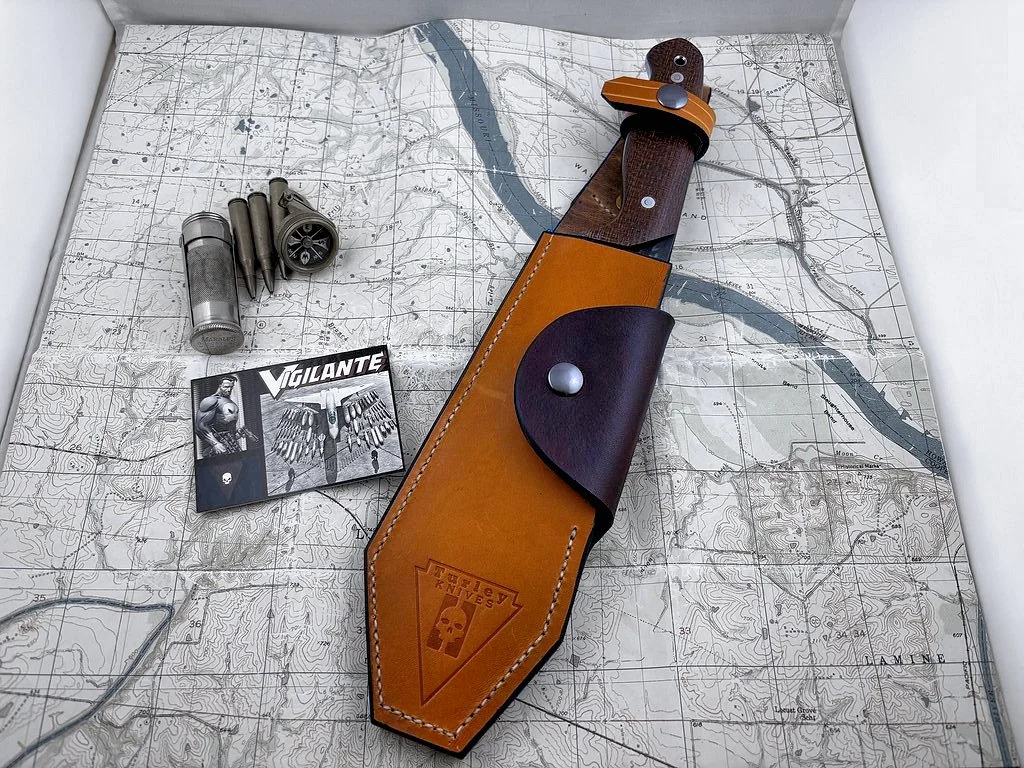
Standard Leather Coffin sheath (handmade using Wickett &Craig and/or Horween premium leather) available: $200.00

M3 Marauder

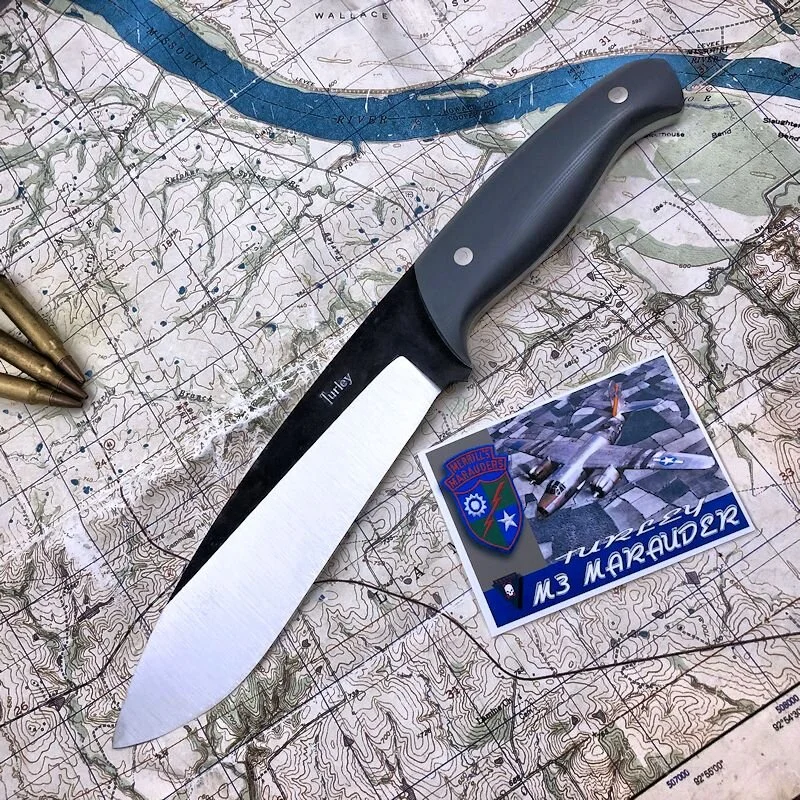
The Model 3 started life in an unusual way, at least it was unusual for me. A  generous friend of mine asked if I’d like a piece of 5160 that he had laying around, I said “sure, I’ll use it”. He told me that it was already in the shape of a knife blank and to do with it what I liked. When it got here it had a big finger guard, a very straight blade and a funky lanyard hole at the pommel. So I drew my template on top of the blank and made it my own. I dropped the point and edge a whole bunch, did away with the “guard” and squared up the pommel. What came out was the Marauder. 
    When I completed it originally I thought I’d only make it the one time but I had enough interest in the knife that I made it part of the regular line up. 
     As for purpose: The Marauder fits in between the Green river and the Missouri in size. It works well for people who like bigger knives for their main woods knife or for people who have large hands. 
Blade length: @ 6 5/8"
Handle length: @ 5"
Thickness available: 3/16" or 1/4” 

Available in 5160 spring steel or o-1 tool steel depending on thickness. Not available with a pommel plate or pommel bolt in a full tang. You an get a bolt pommel on a hidden tang however.
           

Full tang base price: $800.00

Hidden tang base price: $900.00  

More models below, keep scrolling.

M4 Green River

The Green river is a special knife to me. It’s the culmination of my woods time up to this point in my life. It is born out of the Gasconade river, a knife that is very close to my idea of what
a woodsman’s knife should be. After using the Gasconade heavily for a while there were a few small adjustments that I thought could be made to make the knife that much better. That’s
where the Green river comes in.
   Here’s where it differs from the Model 1. It has a slightly longer blade to allow you to baton through wider sections of wood and it has a pommel plate. The pommel plate is the upgrade
that counts most, at least for me. I use my knives hard and in doing so I often use a wooden stick to beat the tip of the knife into wood. Without a pommel plate handle scales will
separate from the tang of the knife. I did it to two of mine before I got wise and added the plate. 

The M1 and the M4 designs are the basis for almost every other knife I make.
   I’ve poured a lot of dirt time into these designs and I’m happy with them, I think you will be too. 
Blade length: @ 4 1/4”
Handle length: @ 4 5/8”
Thickness available: 5/32” or 3/16”

Available in stainless or high carbon steel depending on thickness

Base price with pommel plate: $750.00

Base price without pommel plate: $610.00

Hidden tang price: $750.00

M5 Z-sere and variants

The generation one Z-sere, was for a time the official U.S. Air Force S.E.R.E. Specialist graduation knife. It was inspired by a man named Paul Zinsmeister. Mr Zinsmeister was
an Air Force survival instructor and custom knife maker before his untimely death. I first heard of Paul through my friend Terry Barney who was an instructor at the same time Paul
was. Terry had one of Paul’s big bolo knives and being a knife addict I became enamored with it. It’s one of the finest crafted large knives I’ve ever seen, Paul Zinsmeister was an amazing craftsman. His knives are rare in the extreme so not being able to find one, I made one. Not as well or masterful as Paul did but I gave it a shot. The Z-sere Gen 1 was born.
  The generation one z-sere looked pretty close to Paul’s original design. Making that knife was a lesson to me in just how good of a knife maker Paul was, that knife is very difficult to grind. At least for me it was. It was a big re-curve knife and if you’ve ever used one you’ll know
they aren’t the easiest thing to sharpen.
   So with that in mind, I made the generation two. It’s just as good a chopper as the gen one but it’s easier to sharpen and easier for me to make without pulling my hair out. 
  These knives are amazing choppers inspired by a design that goes back
a long time in the S.E.R.E program. I’m proud to have been a part of it in
some small way. 

Blade length gen2: about 9 1/2"
Handle length gen2: about 5 1/2"

Blade length gen1: about 9"

Handle length gen1: about 5 1/2"

Neither the Generation 1 or the Generation two is available for order at this time. My apologies.

There are, however, three other versions of the Z-sere available, all with the recurve blade design. They aren’t large knives, however. They are all belt knife size and smaller. I decided to make it available in smaller sizes because the recurved blade is so iconic and elegant looking, not to mention handy as a pocket on a shirt.

Medium Z-Sere specifications: Blade about 5 1/4” - Handle about 4 5/8”

Mini Z-Sere Specifications: Blade about 4 3/8” - Handle about 4 1/2”

Micro Z-Sere specifications: Blade about 2 7/8"” - Handle about 3 3/4”

M5 Medium Z-Sere base price: $675.00

M5 Mini Z-Sere base price: $610.00

M5 Micro Z-Sere base price: $550.00

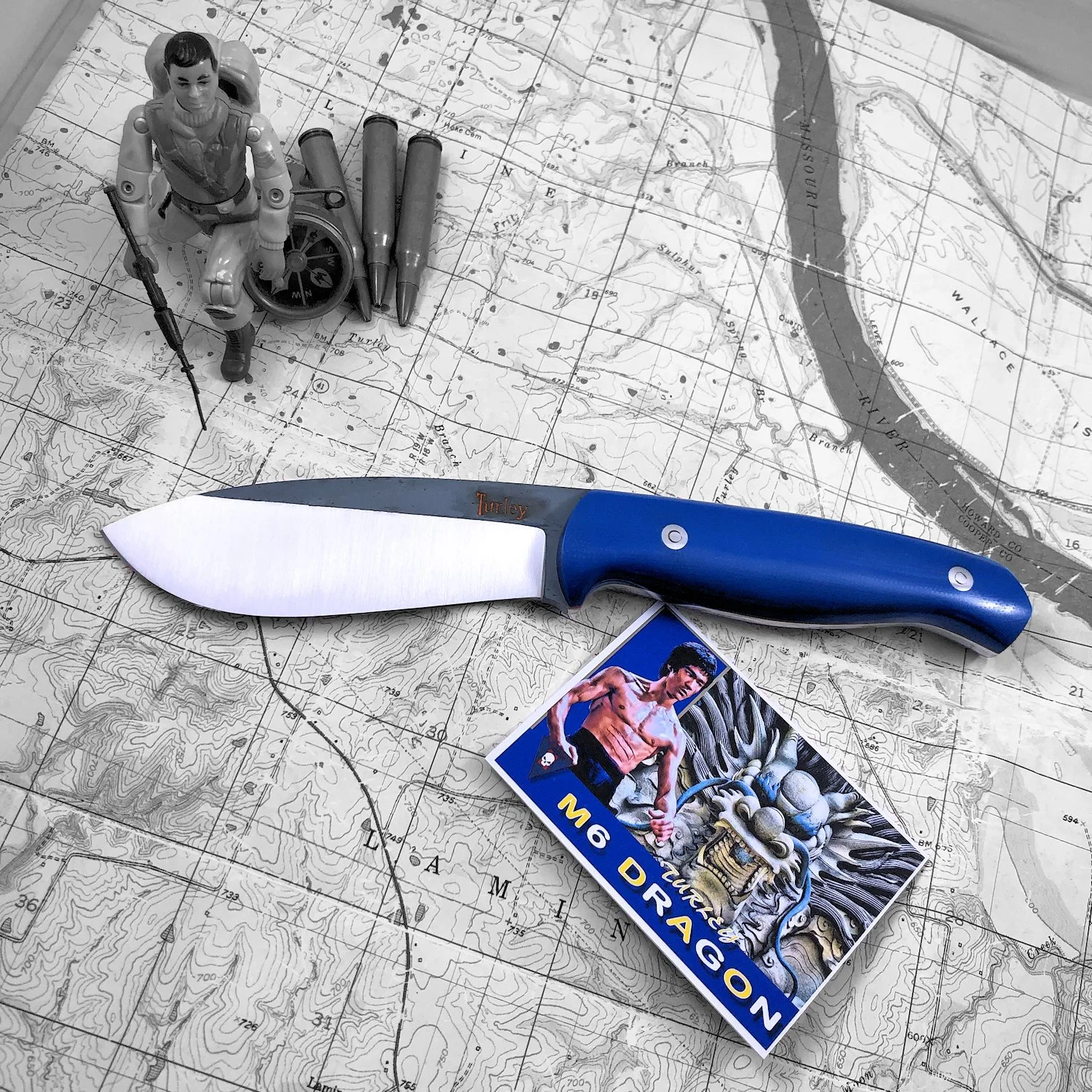
M6 Dragon

The Dragon is similar to the old Dogwood pattern in that I wanted a sort of utility knife. One that was good not only at wood work but also good as a hunting knife. The design itself is a modified Gasconade pattern.
    It incorporates the severe drop point and all it’s benefits combined with a wider blade with some belly up front
for gutting and skinning. The Dragon is a balanced 50% hunting knife and 50% woods knife.
   This is a great all around, do it all sort of pattern. 

Available in hidden tang or full tang construction

Available in tool steel or stainless steel


Blade length: @ 4 1/8”
Handle length: @ 4 5/8”
Thickness available: 1/8” thru 1/4”
Pommel plate not available on full
tang Model # 6

Base price for full tang: $575.00

Base price for hidden tang: $750.00


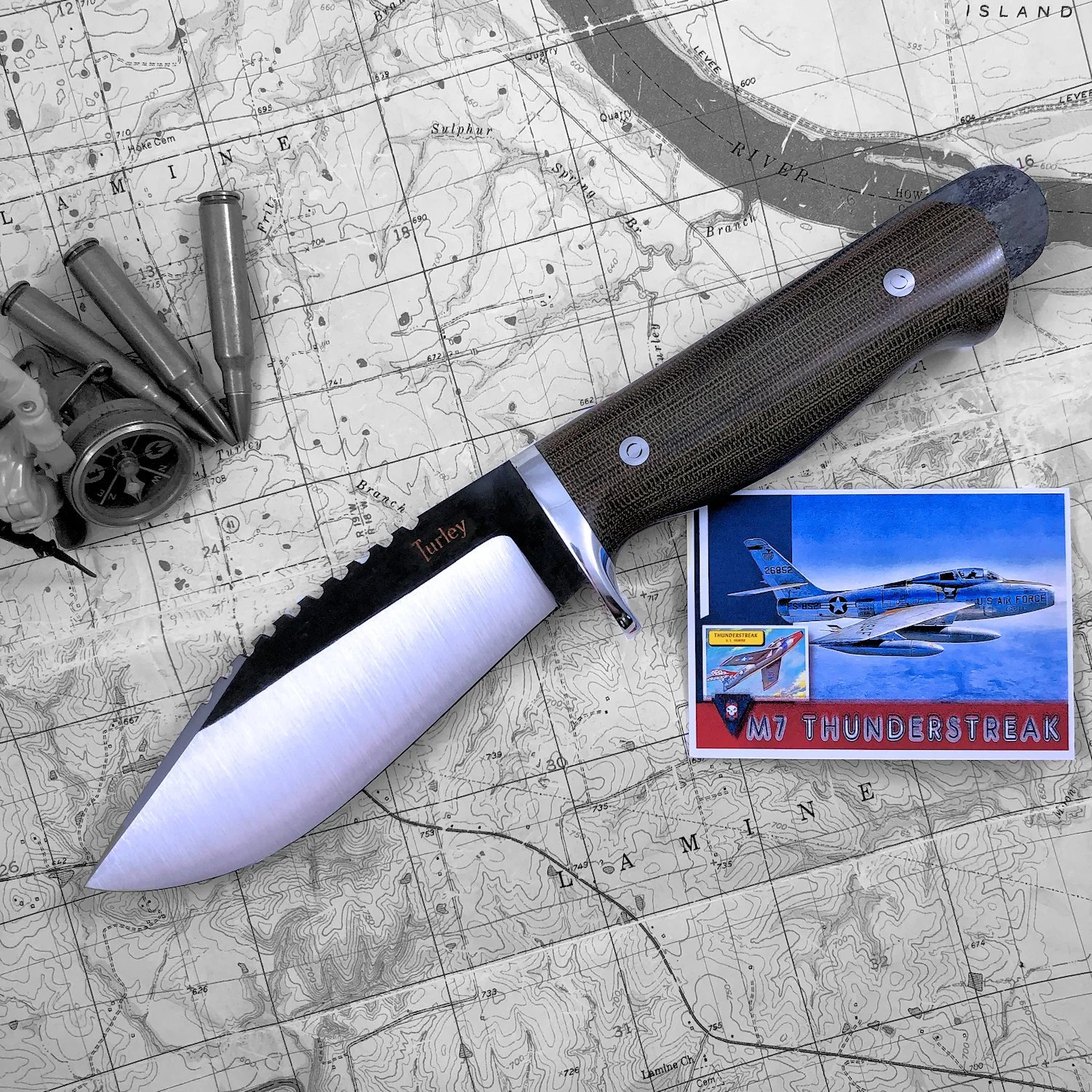
M7 Thunderstreak

The Thunderstreak is my tribute to one of my favorite knives of all time, the Randall model 15 Airman. I've love the Randall 15 from the day I first set eyes on it, especially the early models. 

    I took the key features of the Randall 15 and blended them to my blade style and came up with the Thunderstreak. The blade itself is based off of the Gascoande and Green river design style, the handle and tang style come from the Randall Airman. The Thunderstreak has saw teeth, sharpened front clip, double guard, mortised handle and an exposed tang as standard features. You can order one with no saw teeth, sharp front clip and a single guard if you'd like however. 

     In thicker stock like 3/16" or 1/4", this knife is a tank, combine that with a varied grind or even a near full height and you'll have a tank that cuts like a laser. I really love this thing and can't wait to build one for myself. 

     The knife is named after the F-84 Thunderstreak, one of the coolest jets of the cold war era. 

Blade length: About 5"

Handle length: About 5 1/2"

Thickness available: 5/32", 3/16", 1/4"

Available in tool steel or stainless steel

Available in hidden tang construction

Base price for hidden tang: $800.00 for standard size

 You can also get the M7 Thunderstreak in a “mini” design, which isn’t that mini at all. Since the M7 is such a large knife, the mini is the size of a standard belt sized knife. The mini does not have an exposed tang at the pommel.

The specifications for the mini are

Blade length about 4 1/4”

Handle length about 4 1/2”

Base price for hidden tang: $750.00 for Mini

Not available for order in full or mortised tang versions.

M8 Alamo Scout

The Alamo scout knife is kind of an answer to a lighter more nimble knife that has a more traditional look of some of the old hunting knife patterns and coffin handle bowies. I combined the profile of the old knives with my signature severe drop point design and a forward slanted
guard (on the early models. It may become standard on future models). It’s a neat little knife to use and can be combat tough or a wicked slicer depending on the options you choose.
  The handle is a bit narrower than most of the other models so this one is more suited to small hands, although the bigger handed among us can use it just as well. 
  This knife is my tribute to the brave men known as the Alamo Scouts. Operating in six to seven man teams these men were the
hardest of the hard and suffered training that was almost as severe as combat itself.
  They stalked behind enemy lines from 1943 to 1945, killing Japanese soldiers in their own back yards. The scouts were the first of
their kind, the forerunner to modern special forces units. Their success and lessons learned would be the basis of recon tactics for decades to come.
  In 108 recorded missions, the Scouts killed more than 500 Japanese soldiers without ever losing a single scout killed in combat. This knife is named in their honor. God bless them all. 

Blade length: @ 3 3/4”
Handle length: @ 4 1/2”
Thickness available: 5/32”, 3/16”, 1/4"
No hidden tang option available.

Available in tool steel or stainless steel

Base price for full tang model: $625.00

Base price for hidden tang model: $750.00

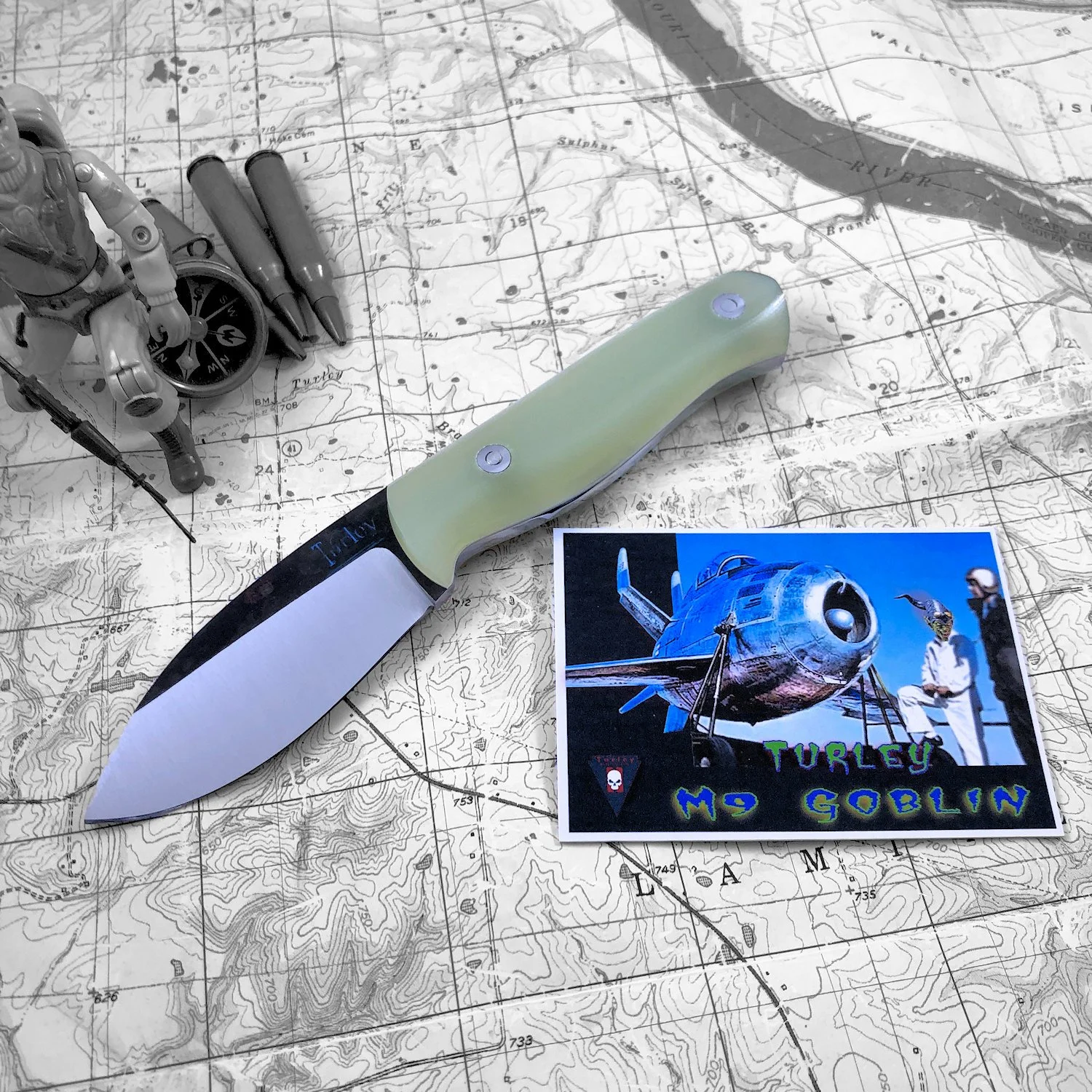
M9 Goblin

The M9 Goblin is what came of a request for a last ditch knife by a friend of mine. He’s a Green Beret with third group who has had multiple tours in the combat zone. He wanted a small version of the Gasconade river to have on him at all times in case he had to ditch the rest of his gear while evading the enemy. I’m proud to offer this knife due to the history behind it and
the personal connection to a friend that it has. 
  Plus it’s a pretty darn useful knife. F.Y.I.  This is a neck knife sized knife. In other words it’s pretty small. And if you want to stay within it’s intended purposes I suggest 3/16” steel with a varied or half height grind. It was intended to be tough more so than a carving or detail work
knife. Small and tough to get you out of a jamb when you don’t have your regular belt knife on you. 
    The M9 full tang comes standard with a thinner than normal handle, for lightness and for less bulkiness in case you'd like to wear it as a neck knife. If you'd like a normal thickness handle, just ask.

(The Goblin name comes from the XF85 Goblin, a short lived fighter jet made in the late 1940s. It was a fat, little "parasite" jet that actually deployed from the bomb bay of a Convair B36 bomber. I figured since this knife is a very small version of a Gasconade and is short and kind of fat looking that the name fit it well.) 
Blade length:  @ 2 7/8"”
Overall length: @ 6 5/8”
Thickness available: 1/8”, 5/32", 3/16”
Hidden tang version also available. 
Steel thickness available in hidden tang
5/32” or 3/16”

Base price for full tang: $525.00

Base price for hidden tang: $675.00

M10 Sea Bee

I’m sure it’s obvious that the Haw Creek takes it’s influence from Japanese blades. I watched a video of a Japanese gentleman who was carving a sculpture using what looked like a meat cleaver that had a sharpened chisel like point. He was a master with it and it struck a cord in
me watching him use it so well. I’m no carver for sure, but I have used a chisel quite a bit in my life for various wood working and carpentry projects I’ve done. I saw immediately how handy something with a flat sharp “tip” would be in the woods. I could imagine how nice it would be to use to make square joints for shelters and camp furniture, for notching traps, friction fire boards etc. Coupled with some saw teeth, the M10 would sing. 
   The Haw creek differs from a true chisel in that the main bevel and front bevel are double sided whereas a chisel is one sided. 
   This knife isn’t what you’d call game knife since it has no tip. But paired with a smaller neck knife that would be used for gutting and skinning, the Haw creek would be one invaluable tool in the woods.

     Although the exposed tang does work for hammering on with a wooden stick, it's not ideal. It provides no protection to the knife handle material like a pommel plate does. So be careful or you'll find yourself with some chipped or cracked handle scales which will not be covered under warranty. 

Blade length: about  3 3/4"
Handle length: about 4 1/2" -with exposed tang about 4 3/4"
Thickness available: 5/32”, 3/16”, 1/4"
5/32" recommended. Any thicker and the cutting efficiency suffers because of the low grind.

Available in tool steel or stainless steel. Hidden tang version available.

Base price for a full tang: $625.00

Base price for a hidden tang: $750.00

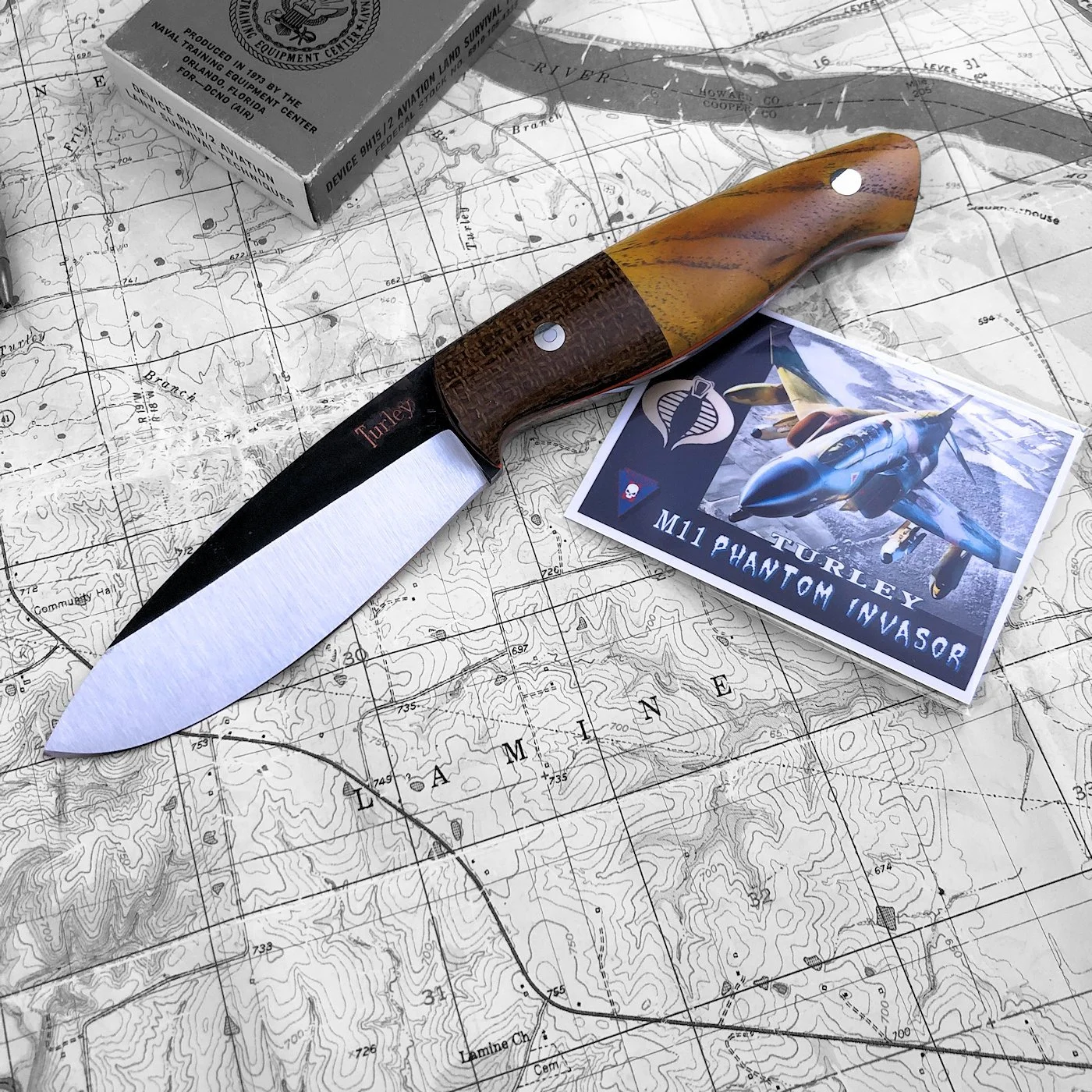
M11 Phantom Invasor

The Phantom Invasor was an experiment to see just how far I could push the drop of a knife pattern. I kept the blade similar to the drop of most of the other models but gave the handle a lot more drop than anything I’ve done before. After using it some I figured out a few things. It is really comfortable to use, probably the most comfortable handle I’ve ever used. 
    The blade works well but not any better or worse than knives in the Gascoande family because it's essentially the same  pattern. A pommel plate on this knife is a bad idea, I found that out after I made the prototype with one on it. The handle has too much drop in the  pommel to make a pommel plate an effective striking area. The plate is set at an impractical angle for striking.
  The other thing I learned is that if the knife were dropped any more than this it would probably lose most of it’s effectiveness, there’s no reason to go any farther. 
   My conclusion: Extremely comfortable knife to use. Does every woods task you need it to for a knife without a pommel plate. 


Blade length: @4”
Handle length: @ 4 1/2”
Thickness available: 1/8” thru 1/4”
No hidden tang version and no pommel plate version of this knife available

Base price: $610.00


M12 Crusader

The Crusader came about once again from my buddy with 3rd group Special forces. He was in the higher elevations on his last deployment and needed a light yet tough knife, so I came up with the Model 12.  The Crusader comes standard in 1/8” thickness with a full height grind and no pommel plate to keep it as light as possible. The blade has the severe drop characteristics of the Gasconade family, you can check out the reasons for that by reading more about the model 1 Gasconade river. 
  The Kunar has a bull nose tip for strength which is still enough tip for drilling and gutting game. 
  The light version comes with thinner than normal scales but if you’d like it slightly more comfortable for long use I can put on standard thickness scales instead. Just let me know.
  
Blade length: @ 3 3/4”
Handle length: @4 3/8”
Thickness available: 1/8” or 5/32"
Grind: Full height or near full height (only on 5/32")

 Hidden tang version available only in 5/32” thick. This is the lightest version available. 

Available in tool steel or stainless steel.

Base price for full tang: $610.00

Base price for hidden tang: $750.00
 

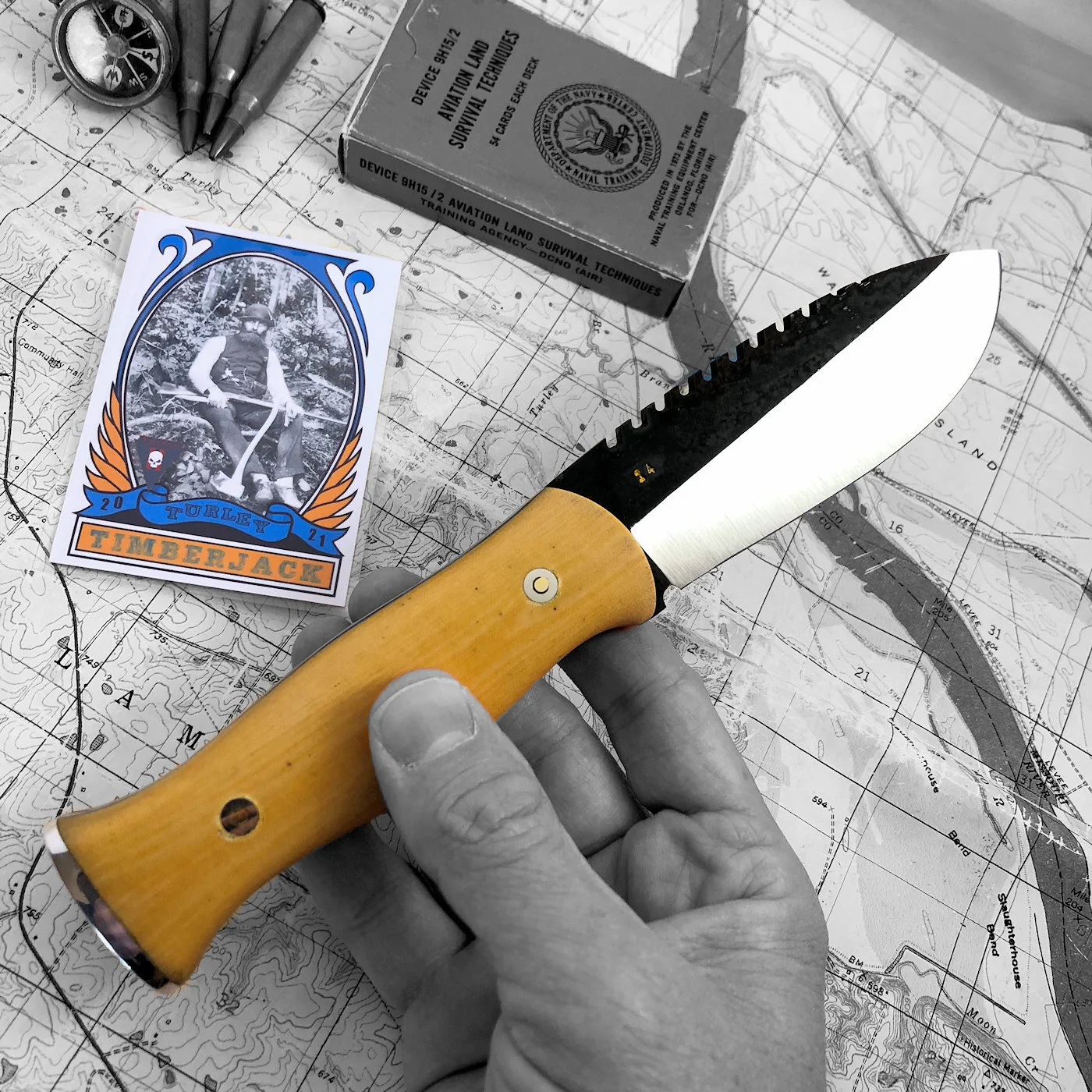
M13 Timberjack

The Timberjack has the same blade characteristics of the Green river but is wider and has the same advantages due to the standard pommel plate. The handle shape is inspired by the Randall commando style and the Leuku Sami knives. I thought the handle style looked comfortable and seemed like it would give the user a good grip on the knife. It does both pretty good. This knife is not available without a pommel plate. 
 

Blade length: @ 4 1/8”
Handle length: @ 4 1/2”
Thickness available: 1/8” thru 1/4"

Not available in hidden tang version

Available in tool steel or stainless tool.

Base with pommel plateprice: $750.00
 Base price without pommel plate: $610.00

 Base price for hidden tang: $750.00

M14 Thunderbolt

This knife is based off of the jet pilot survival knife that Marble’s designed for the Bureau of Aeronautics, Dept. of the Navy beginning in 1953.  At least that when talks and the designing of the knife began. Unfortunately after getting what they could from Marble’s the government cut the company out of the bidding process for the contract. It went on to other, smaller companies and became an icon which remains to this day. This knife pattern, more than any other American knife and most other non American patterns, has seen more actual survival use than any other. It has been used since the early 1950's by USAF Survival Instructors/Sere Specialists to teach the tactics of survival to Air crew members and persons at risk. Nearly every day of the year, for 60 plus years. I has been used by pilots in actual survival incidents on many occassions. Needless to say, it is a proven design and imbodies American survival and bushcraft. 
  As with some of my other knives, this one takes it’s inspiration from the past. I try to put my own spin on projects like this so that it is a homage instead of a direct copy. I also try to incorporate what I think is useful in the design and drop what I feel isn’t. With that in mind
the handle of the Model 14 is similar to the original but the blade is completely different. It comes standard with a Model 4 Green river blade that is matched to the handle.  
   Although the Green river blade is standard, you can request almost any blade I make with the Model #14 handle.  

Pilot rescue and survival is something that means a lot to me and I wanted to honor the knife that helps make that happen.

 Can be requested without saw teeth but there is no price reduction.
 Blade length: Dependent on the blade chosen
Handle length: Usually at least 4 1/2"
Thickness available: 5/32” thru 1/4”

Standard with nickel silver guard (hidden tang has a guard, full tang does not) and 1018 steel bolt pommel.

Available with brass furniture +$40.00 or Copper furniture +$60.00

Hidden tang price for standard Green River blade : $750.00

Full tang price for standard Green River blade: $750.00

Price varies for other blade options.


M15 Air Assault

The Air Assault takes it’s inspiration from the Randall knives model 18 attack. The Randall knife was a joint design between Captain George Ingraham, Bo Randall and Gary Randall. Captain Ingraham was a Ch-21c helicopter pilot serving in the Vietnam war at the time of his request for the knife. Every thing about the knife, at least in Captain Ingraham’s assessment, was geared for helicopter pilots and crew members needs. I’ve tried to stay faithful to those designs while still incorporating my own design.
   The Model 15 features a stainless steel knurled hollow handle for items of your choosing. 
  Don’t let people tell you that all hollow handle survival knives are weak like the ones they remember that were sold in chain stores in the 1980’s. This is not that kind of knife, I guarantee it to be absolutely tough enough for anything you can throw at it in the woods.
  Available with any blade up to 5" length

Thickness available: 5/32", 3/16", 1/4"

Handle length: about 5"

Not available for order. 

M16 Recondo and Apollo Bolo

I use a machete/bolo pretty often, all spring, summer and into the fall a bit. In all that use however I noticed that I very rarely used the tip of a
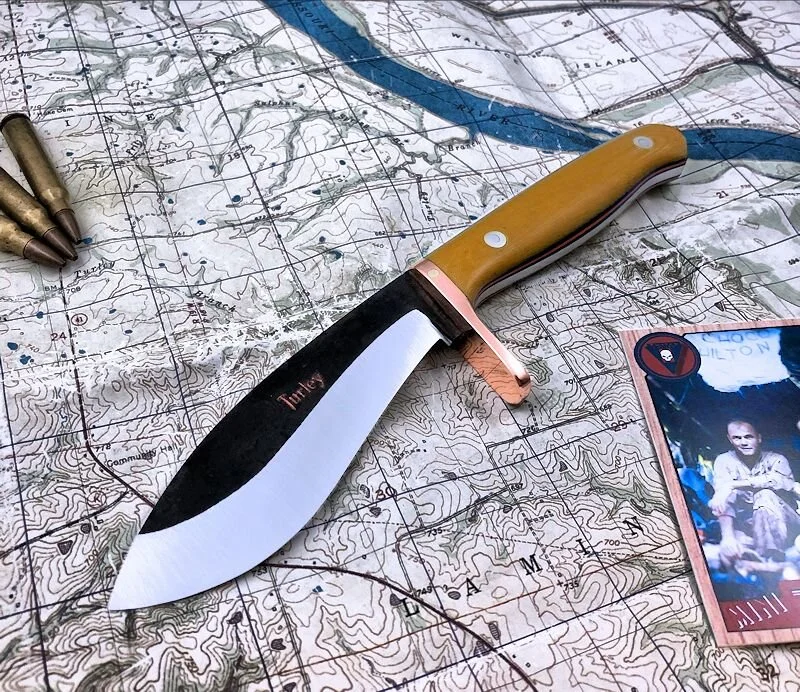
big knife for anything. I decided to make a machete that I could use to dig with if I had forgotten my shovel, if I was in a hurry or for small quick work. I remembered seeing a U.S.M.C. round tip bolo that was used during ww2 and thought I’d make a version of that with my design influence thrown in. What I drew out looked almost exactly like the knife pictured.
   A few days later I stumbled onto the C.I.S.O. ( Counterinsurgency support office) supplied S.O.G. (studies and observation group) bolo
 that was used by American Special Forces soldiers while running recon missions in Laos and Cambodia. Then and there I knew this was the
knife I wanted to make so that I could do my small part to honor those veterans who did such a difficult, dangerous and vital job during the
Vietnam war. 
  In honor of 5th Special Forces group I have named this knife the Recondo bolo. 5th group hosted the Recondo (Recon and Commando) school and trained members from all services in the skill of  reconnaissance and commando tactics in Nha Trang Vietnam from 1966 to 1970.
The knife is meant to be used to do light digging with and inevitably it will hit rocks. Expect the tip to chip or roll if you do this. A file
Will fix it back to using condition. 

    Traditionally, these knives were made of 1/4" thick steel, they were obviously not used as a machete being that heavy. Their main use was for clearing hasty firing lanes, digging quick holes for booby traps and hasty clearing of LZs (landing zones) for helicopter extraction. A secondary use was for back armor, the S.O.G. men used to put these bolos down the back of their ruck sacks, between the frame and the pack. A great place to carry them and it might just help if you caught a round in the back. 

    If you want a semi light knife for more machete type work then you should order the "light" Recondo bolo which is made of 1/8" thick steel. It's definitely not a machete,  but its lighter than the heavy version. It comes with only the "standard grind" which is a low height grind. 

 If you want more of a chopping knife then you should go for the "Heavy" Recondo bolo which is made of 1/4" thick steel. This is the traditional version and can be made with a much higher grind for deadly serious penetration when chopping. 

Apollo Machete


   The Apollo machete is named in honor of the NASA Apollo missions of the 1960's. I love American history and any chance I get, I do my best to highlight American heroes. The early Astronauts were heroes in my mind. Going where few had gone before, into the unknown and risking the possibility of not being able to ever return. I admire that.

    In the early days of the space program, NASA contacted Bo Randall about making a machete that would be on board the space capsules and stored in the survival kit. Bo declined and recommended NASA contact Case knives, which they did. Case made the Astro Machetes based off of the specifications provided by NASA and these knives are collectors items today.

The Apollo is my tribute to the Case Astro machete. It looks nothing like the original Case, which was a standard machete profile with saw teeth, but instead incorporates my design style.  It is the same knife as the Recondo but with an actual tip and not available in a heavy version. It is available in ultra thin 1/16" steel only, which makes it a true machete, light and quick. Saw teeth are an option and not standard. 

No hidden tang option on either knife

These knives are available to order but are subject to the steel being available. The steel supply on these is spotty at best, so just ask when your name rolls around to the top of the list if you're interested in one of these. 

1/16" and 1/8" knives will be made from 15n20 steel

1/4" knives will be made from 5160 spring steel 

Recondo blade length: about 11 1/2"

Apollo blade length: about 11 5/8"

Handle length for both: about 6 3/8"

Not available for order.

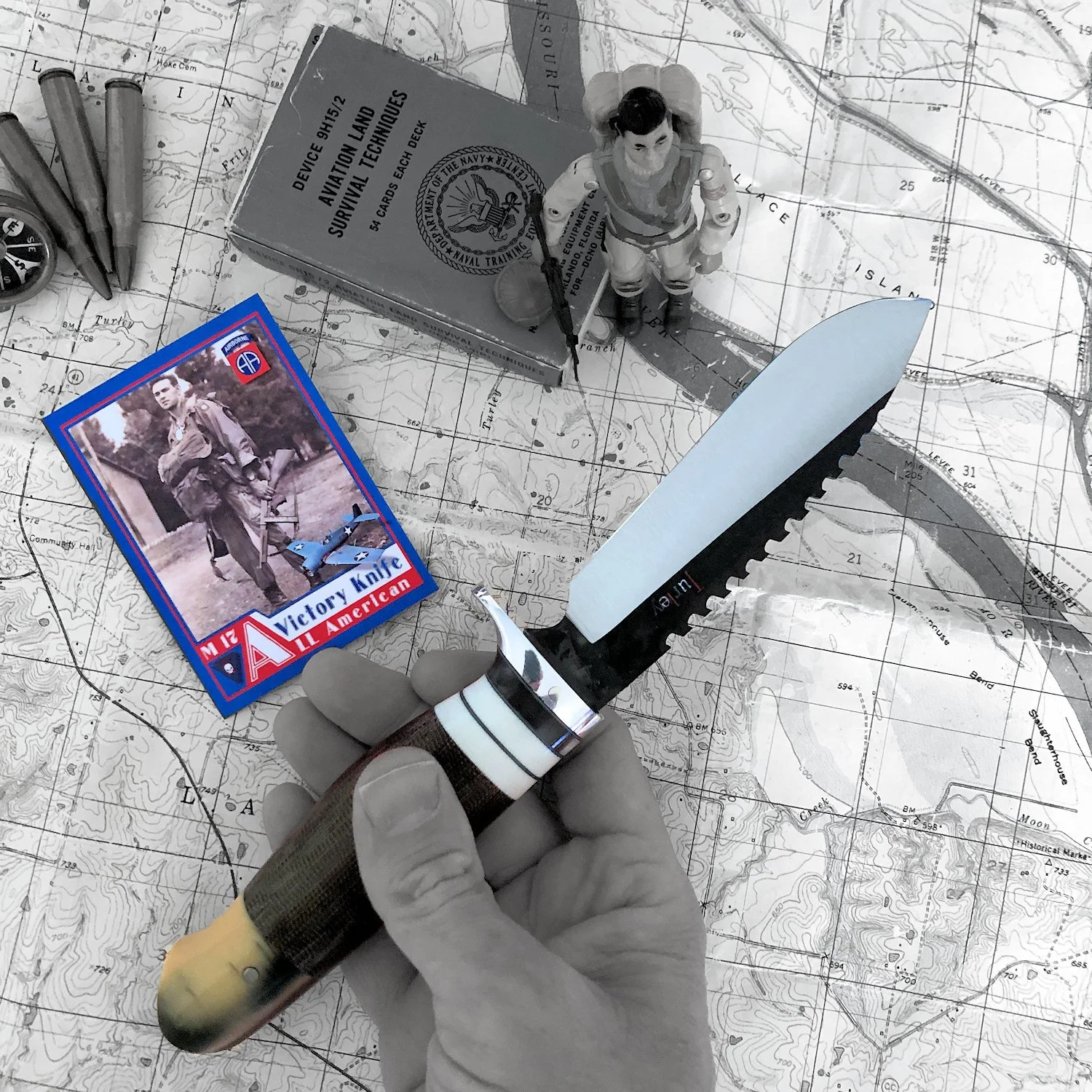
M17 All-American Victory Knife

This is the All American Victory knife, so named to honor all those Americans who gave their time, energy and lives to liberate the
oppressed during World War two.
   The blade on the A.A.V.K. Is virtually identical to the old Green River. The only difference is a slightly humped back all along
the spine. 
   Each model 17 will come with (regardless of handle materials) a section of plexiglass from the cockpit of an F6F Grumman
Hellcat. The piece is from an  original push out cockpit panel circa 1943. Each knife will come with a photocopy of the original tag showing the part number of the push out panel. 
    Once I use up all of the original cockpit material, this knife will no longer be available. That is unless I can find something as equally historically significant to incorporate into the handle.
     Only available in hidden tang form

Blade length: about 4 5/8"

Handle length: about 4 1/2"

Base price $750.00

Only available in hidden tang construction.

M18 Raider Machete

Anybody who is into knives knows what the Marine Raider (or Gung ho) knife is, the model 18 is my version. It is pretty close to the original
in basic design except I made it a drop point instead of a clip point (you can order one with a clip point if you prefer) and I did away with the guard (you can also order one with a guard if you like. Heavy model only). Other wise (except for changing the handle shape) the Model 18 is essentially the same pattern as the old Collins knives.
   You probably noticed that this knife is called the Raider machete and not the Raider bowie. That, of course is intentional. I wanted to honor
both the Marine Raiders who so successfully used this knife and also honor the U.S. Army Air Force pilots who used this knife before the raiders themselves. Hence the machete part of the name because that is what Collins made it to be. The original intent was not as a fighting knife, but a bail out/survival knife issued to pilots in the early part of the war. And by most accounts this is also what the Raiders used their bowies for. Same knife, different name, but used in the same way. The only difference was that the Raiders depended on their knives almost daily while behind enemy lines where as a pilot may never (thankfully) have the chance to use his when it counted most.     
    In my opinion, those who say that a big knife is for a novice, someone who doesn’t know what they are doing in the woods, should study the Marine Raider knife and it’s actual use by those men who made it famous. From all accounts I have read, it was used mostly as a survival tool, not a fighting knife and they used it well. From John Wukovits’ book American Commando comes an interesting quote. Former Marine Raider Jesse Vanlandingham states “I had to find a dead tree that I could cut through the outer part, that was wet, and get some dry wood out of the center of the tree. I had a pretty good fire going right next to a tall tree shelter.”  You and I would recognize that description he is giving as a split wood fire. Granted, he doesn’t say he used his Raider knife but I’m guessing that’s likely what he had with him and what he used. I've also read reports of these knives being used to cut firing lanes in combat. I’ve read more than one report of how useful and handy the Raiders thought these knives were. That’s good enough for me. 

    The Raider is available in two different configurations of your choice. A heavy model, made of 1/4" 5160 spring steel and a light model made of 1/16" 15n20 carbon steel. If you want to cut a trail through the jungle then pick the light version. If you want to use it like a hatchet or machete then go for the heavy version. 

    The light model comes with only one grind, that is the low grind you see above. The heavy model can be ordered with a half height, commando or reverse grind. 

    Light models are much easier to make and therefor much cheaper for you to buy.

Handle length about 5 3/4"

Blade length about 9 1/2"

Thickness available: 1/16" or 1/4"

Not available for order